Laparoscopic surgery for ectopic pregnancy
Fast and safe care with preservation of reproductive health
Ectopic pregnancy is a dangerous condition when the fertilized egg attaches not in the uterus, but most often in the fallopian tube. This requires immediate surgical intervention, as a ruptured tube threatens the woman’s life. At St. Luke’s Clinic (Banchery village), we perform treatment using the method of laparoscopy — through micro-punctures, without a large abdominal incision, with maximum effort to preserve the fallopian tube and the ability for future conception.
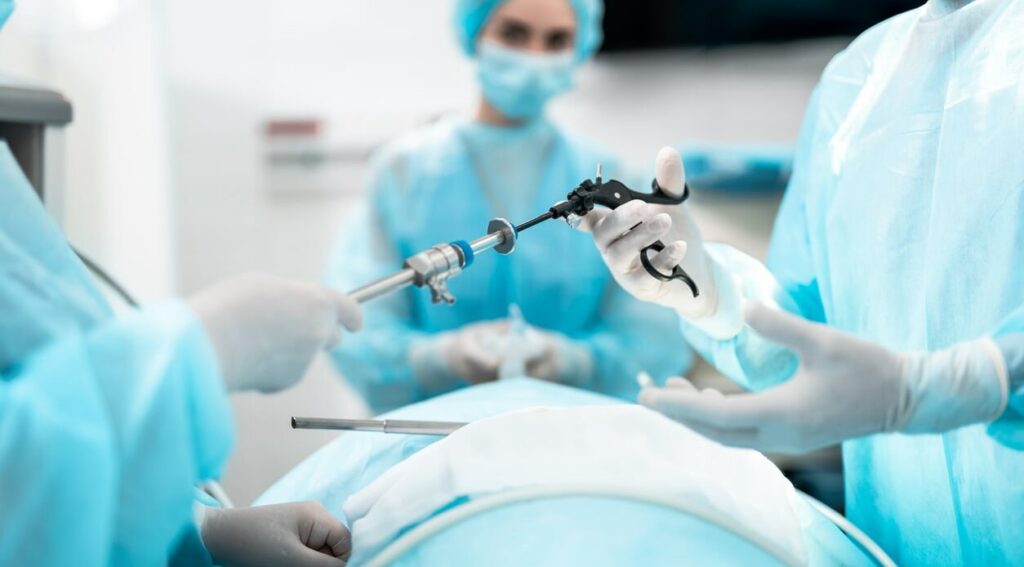
Why is laparoscopy the standard of treatment?
Unlike outdated open surgeries, laparoscopy allows the surgeon to operate with precision under the control of a video camera with high magnification.
- Minimal invasiveness: Instead of a scar across half the abdomen — only 3 inconspicuous marks from punctures (5-10 mm).
- Less pain: The postoperative period is significantly easier, with minimal need for painkillers.
- Quick discharge: The patient can leave the clinic as early as 1-2 days after surgery.
Organ-preserving surgery: can the tube be saved?
The main question of our patients: “Will I be able to get pregnant afterwards?”.
The tactics of St. Luke’s Clinic surgeons depend on the gestational age and the condition of the organ:
- Tubotomy (tube preservation): If the diagnosis is made in time and the tube is not ruptured, we make a neat incision, remove the fertilized egg, sanitize the cavity, and “seal” the vessels. The tube remains functional.
- Salpingectomy (tube removal): If the tube has ruptured or is severely deformed, it must be removed. However, even with one tube, spontaneous pregnancy is absolutely possible.
Symptoms: when should you urgently see a doctor?
Do not delay your visit if you notice:
- Missed period and a positive pregnancy test.
- Dull or sharp pain in the lower abdomen (often on one side).
- Spotting or bloody discharge.
- No fetal egg visible in the uterine cavity on ultrasound, although the test is positive.
How is the surgery performed at St. Luke’s Clinic?
The intervention is performed on an emergency or planned basis in a modern operating room.
- Anesthesia: General anesthesia (the patient is asleep).
- Course of surgery: A camera is inserted through the navel, and instruments through two other punctures. The surgeon removes the ectopic pregnancy, stops the bleeding, and washes the abdominal cavity (to prevent adhesions).
- Duration: Usually 30–50 minutes.
Recovery and planning for future pregnancy
Thanks to the skill of our doctors and modern equipment, rehabilitation is as quick as possible. We provide recommendations for anti-inflammatory therapy and contraception during the recovery period (usually 3-6 months), after which happy motherhood can be planned again.
Your health and future are in reliable hands. If you suspect an ectopic pregnancy, contact the gynecological surgeons at St. Luke’s Clinic immediately.