When a patient suffers from a very severe or rapidly progressing illness, intensive continuous monitoring is required. In such cases, it is often necessary to use equipment to support vital bodily functions: heartbeat and breathing. To provide such care, the hospital has a specialized department, abbreviated as RICU (Resuscitation and Intensive Care Unit).
Patients can be admitted to the resuscitation department either directly upon hospital admission or transferred from other therapeutic or surgical departments.
Indications for hospitalization in the RICU:
- Impaired consciousness (in extremely severe cases, up to a comatose state) or unexplained severe agitation (screaming, crying).
- Respiratory distress: onset of intense shortness of breath, cyanosis, flaring of the nostrils, groaning and grunting breathing. The respiratory rate significantly increases (more than 30 breaths per minute).
- Cardiovascular system disorders (sharp drop in blood pressure, various forms of arrhythmia, and cardiac arrest).
- Shocks of various etiologies. Shock can be traumatic, hypovolemic (due to a drop in blood pressure), cardiogenic (due to heart failure), infectious-toxic, anaphylactic, and neurogenic (due to spinal cord injury).
- Disorders of the circulatory system. Typically manifested by signs of hemorrhagic syndrome (blood clotting defect).
- Signs of liver dysfunction. Determined by clinical blood analysis results. Visually, it may manifest as yellowing of the skin and mucous membranes.
- Onset of acute renal failure. Manifested by a decrease in diuresis or complete cessation of urination.
Post-operative patients recovering from general anesthesia are also mandatorily admitted to the resuscitation department, as they require careful monitoring.
After stable patient stabilization, they are transferred to a standard ward for further treatment.
RICU Structure
The resuscitation department can be conditionally divided into 2 parts:
- Treatment. This is where patients receiving care are directly located. It includes a resuscitation room and an ICU (intensive care unit).
The treatment part also includes a treatment room and a biochemical laboratory for express tests.
- Service. This includes the nurses’ station, doctors’ lounge, various equipment rooms, and technical facilities.
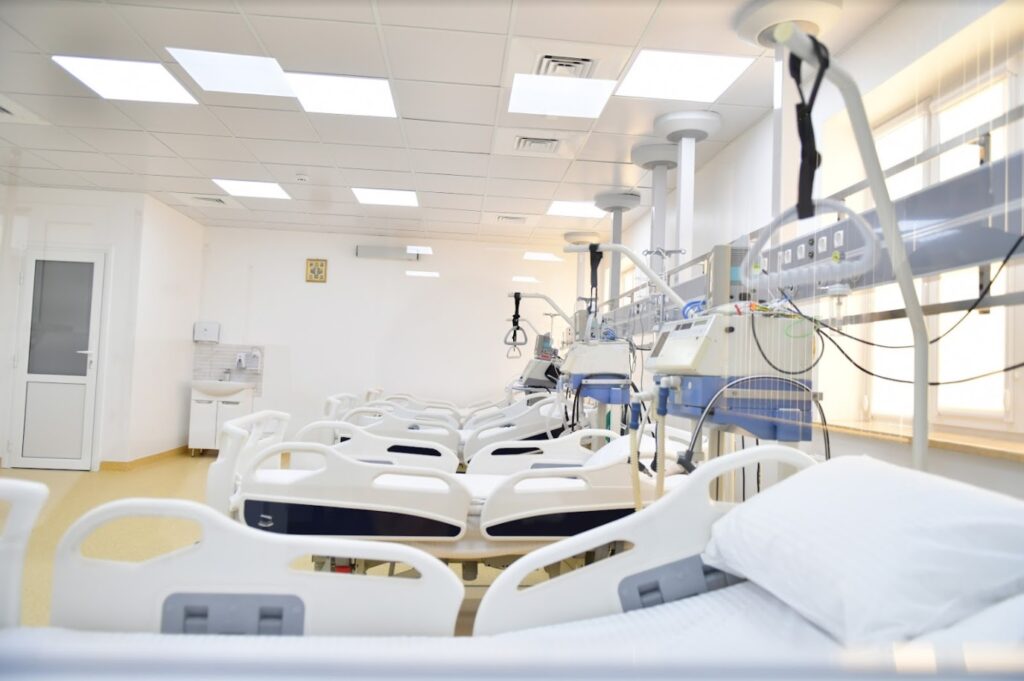
Undoubtedly, the most important part of the department is the treatment area. For high-quality emergency care, it must be equipped with a range of specialized resuscitation equipment.
The list of mandatory devices includes:
- Mechanical ventilator (artificial lung ventilation).
- Portable ultrasound machine (ultrasound examination). Used for procedures such as puncture and catheter placement.
- Monitor to track the patient’s vital signs.
- Defibrillator and pacemaker, used for various forms of cardiac arrhythmia.
- Anesthesia and respiratory machine.
- Device for tube feeding.
At St. Luke’s Clinic, the RICU is equipped with the latest equipment necessary for emergency care and intensive therapy.
The department also has a special reliable ventilation and air conditioning system, ensuring a high degree of air purity. Along with competent antiseptic measures, this fact contributes to the rapid improvement of patients’ condition and reduces the risk of developing secondary nosocomial infections.
RICU Staff
Doctors of the intensive care department are highly qualified specialists. All of them, without exception, have undergone specialized postgraduate training and continue to regularly improve their knowledge and practical skills.
Mid-level medical staff also have extensive experience in resuscitation departments and are proficient in emergency care techniques. Additionally, nurses must be able to independently perform a number of complex procedures:
- administer infusion therapy and perform injections;
- monitor the body’s fluid balance (by accounting for diuresis, fluid loss through tubes and drains);
- aspirate exudate from the pleural cavity and sputum from the airways;
- perform bladder catheterization;
- monitor the operation of control monitors and be able to read and evaluate necessary indicators.
Regular rounds are conducted in the department with the participation of the chief physician, head of the department, and attending physicians to monitor patients’ condition and evaluate therapy results.
Seriously ill patients are never left unattended for a second. Anesthesiologists-resuscitators and nurses are on duty around the clock in the department. The nursing station is located so that all beds are within the duty officer’s field of vision.
Thus, thanks to the availability of high-quality, latest-generation equipment and highly qualified personnel, our resuscitation and intensive care department successfully treats patients with severe diseases and provides timely emergency care.